
From Alghero to Cagliari by Bike: Discovering the Wild Nature of Western Sardinia
Sardinia is undoubtedly a perfect destination for cycling outside the peak tourist season. A mild climate, picturesque landscapes, and an ancient history waiting to be discovered—these are the ingredients that make this region a unique and special place.
Not to mention the food and wine tradition linked to cheeses, delicious meats, and fresh fish, which conquers any palate at any time of the year. In short, although it is an Italian island that is very convenient to reach by ferry or plane, Sardinia manages to create its own well-defined identity. Traveling through its interior allows you to discover a history and culture very different from what we are used to on the “mainland.”
Departure from Alghero: A Journey into Authentic Sardinia
To get to know this territory best, I explored the entire western coast on my bicycle, stopping pedal stroke after pedal stroke in the most characteristic villages, the most striking beaches, and in front of the most picturesque views.
I set off from Alghero and covered about 600 km, visiting the wonderful towns of Bosa, Cabras, and the Sinis Peninsula, the dunes of Piscinas, and the centers of Buggerru and Carbonia to reach Sant’Antioco. I then concluded the journey amidst the enchanting beaches of Porto Pino and Baia Chia. Even off-season, I always easily found places to eat and sleep—a sign of a region that wants to invest in slow tourism, away from the crowds.
First Stage: Bosa, Between the Sea and Fine Wines
The first stage was very short: I rode 40 km from Alghero Airport to the small town of Bosa, with about 500 meters of elevation gain. And what a show! The road connecting these two northwestern Sardinian centers is truly spectacular and has nothing to envy compared to foreign paradises like Hawaii or the Canary Islands.
The asphalt unfolds in a series of ups and downs through mountains overlooking the sea, offering splendid glimpses of coves, cliffs, rocks that seem hand-drawn, and lush vegetation. Everything is seasoned with Sardinia’s classic sharp and spicy scent, a land constantly kissed by the sun, much like the succulents present everywhere.
Bosa is a small town divided in half by a canal connected to the beach. In summer, everyone moves to Bosa Marina by the sea; in winter, everyone lives in the narrow alleys surrounding the hilltop castle. These streets are paved with cobblestones and lined with colorful houses and wine bars.
Wine bars, because one of Bosa’s specialties is its Malvasia, one of the few wines in the world produced through barrel oxidation. This wine can age for a very long time thanks to the presence of “flor” inside the barrel—a special mold that protects the wine from oxygen, allowing a slow exchange that enriches the drink with unique notes ranging from almonds to citrus. Try a glass; you won’t regret it.
From Bosa to Cabras: Discovering the Sinis Peninsula
The itinerary connecting Bosa to the Sinis Peninsula is a spectacular journey (though not the easiest: 70 km in total with about 600 meters of elevation gain). First, you cross a flat lagoon with valleys and stretches of water rich in vegetation and wildlife. Then, you climb back up the hills to find yourself on a promontory reminiscent of the American Monument Valley, thanks to the fun shapes recreated by the rocky peaks.
Enchanting Beaches and Archaeology: Is Arutas and San Giovanni in Sinis
Finally, you reach the sea via a long, fun, and seemingly infinite descent that leads straight to the beach of Santa Caterina di Pittinuri, which welcomes you with crystal-clear waters and a brilliant white cliff. From here, you proceed along the coast first and then inland, crossing fields and cultivated expanses to reach the marvelous beach of Is Arutas—it is impossible not to stop for a swim. In fact, besides being set in a wonderful natural environment, this beach is very unique because its sand consists of tiny grains of quartz that resemble diamonds. It offers a true spectacle of reflections that will captivate you, as will the beauty of the fish you can spot while swimming just offshore.
From Is Arutas, a dirt trail through the dunes leads in just 10 km to another wonder of the Sinis Peninsula: San Giovanni in Sinis. This is a promontory of beautiful dunes and beaches surrounded by highly significant archaeological excavations.
It is right here that the famous “Giants of Mont’e Prama” were found: ancient sculptures dating back to the Nuragic civilization, discovered in 1974. Ranging between two and two-and-a-half meters in height, they represent archers, warriors, and boxers. Mont’e Prama is the oldest and largest statuary complex in Europe. You can admire them along with other finds inside the Civic Museum of Cabras, a town about 10 km from San Giovanni where I finished my second day. It is a small town overlooking a huge lagoon. Be sure to try bottarga (cured fish roe), a typical local product.
From Cabras to the Mountains of Sa Perda Marcada
The itinerary I covered on the third day was very strenuous. From Oristano onwards, much higher mountains begin and there are no longer roads running along the sea; to visit the beaches, you have to climb up and down the highest peaks. In total, I cycled about 70 km with over 1,000 meters of elevation gain, but in return, I saw fantastic places.
After leaving Cabras, I passed Oristano and crossed a small village along the way called Arborea: a Venetian enclave colonized during the fascist era. Don’t be surprised if you hear people speaking the Venetian dialect as if you were in Venice, or if the architecture reminds you of villas in Northeastern Italy. Next comes Marceddì, with its lagoon and the long, striking bridge that crosses it.
The Climb
From here, a tough, rewarding climb begins, consisting of many ups and downs through the wildest mountains. It is a very enjoyable road, as it offers a glimpse into the promontories of the Sardinian hinterland. Here, you are completely isolated and lost in the middle of nature.
To descend toward the sea from these heights, you must take small, partially unpaved roads, though they are never too technical. It is a real joy for lovers of local flora and fauna (you encounter all kinds of animals).
Descending toward the coast, the first seaside location you come across is Portu Maga, a beautiful beach with crystal-clear water and a few tourist services like bars and restaurants. But the real gem lies 7 km from here: Piscinas Beach. This is a 28-square-kilometer area entirely covered by wild sand dunes—the largest in Europe. Reaching it requires some effort: you must tackle a very rough dirt road for about 5 km, ford two rivers, and walk for a bit through the sand. A true Sardinian “safari.”
Furthermore, just a few kilometers from this beach lies a striking “ghost village,” Ingurtosu. It is an ancient metal mining center, now uninhabited, where you can still admire the old buildings, washhouses, shafts, and rail tracks that connected the outposts. The atmosphere is truly eerie. From here, the road climbs up the mountain, passing through villages with very few inhabitants; let yourself be charmed by the views and the simplicity of slow-paced life. It is not uncommon to spot a deer while cycling uphill: pure magic.
Once I reached the top of the mountain, I stopped at the splendid farmhouse of the Sa Perda Marcada educational farm. There is absolutely nothing around—just endless, enchanted nature.
Exploring the Mines: Buggerru and Masua
The history of the mining industry is the common thread running through this entire area of Sardinia. From Ingurtosu to Carbonia, all the towns are rich in former processing plants, caves, mines, and disused railways. The elevation changes make themselves felt in this area because it is a continuous series of climbs and descents, but the views make every effort worthwhile.
The first stop on the fourth day was Buggerru, a town known since Roman times for its silver, which produced more than one million tons of zinc and 200,000 tons of lead up until 1979. Its small harbor is dominated by the exit of the Henry Tunnel—now an open-air museum—where a train once ran to transport the extracted ore.
From this point onwards, the beaches return. Definitely noteworthy is Masua, with its wide shoreline and crystal-clear water, though the most striking of all remains Cala Domestica, with its cliffs and hidden caves. The day’s itinerary ended in Carbonia, a modest small town that features a train station and lies a stone’s throw from Sant’Antioco.
I wanted to spend the fifth day relaxing, cycling around the splendid beaches of Sant’Antioco—the island off the island of Sardinia. Here, you can ride a very scenic loop of about 25 km, entirely paved, which leads from the charming seaside town (featuring a harbor rather than a beach) to Calasetta, a small port with a historic center and the wonderful beach of La Salina. On this island, everything is extremely simple and natural; the crystal-clear water is framed by sand dunes and very few commercial businesses.
Proceeding along the western coast, you can admire several beaches from above—some sandy, like Cala Lunga and Cala Sapone, and others rocky, like Cala Grotta and the Arco dei Baci (Arch of Kisses), which will enchant you especially at sunset. Be careful, though, as the wind here is very strong: if you want to go for a swim, check the current first.
Finally, crossing the island’s almost desert-like nature, you reach the east coast again, featuring the beaches of Coaquaddus and Maladroxia, or the easier-to-reach Portixeddu. You then return to Sant’Antioco by crossing the industrial area, finding yourself back in its maze of colorful streets. A quick tip: if you pass through here, visit the I Vinattieri wine bar, because Sandro, the owner, will have you taste the best local specialties.
This stretch of coast, now in southern Sardinia, is perhaps the most spectacular for its beaches and the road built directly along the cliff. The elevation gains flatten out a bit—though they are still present—offering plenty of opportunities to choose where to dive in while admiring the view from above. The first location, unmissable for sea lovers, is Porto Pino: a long expanse of white sand with crystal-clear waters, surrounded by dunes and wild vegetation. There are also numerous beach clubs in this area if you want to have lunch or rent a sunbed.
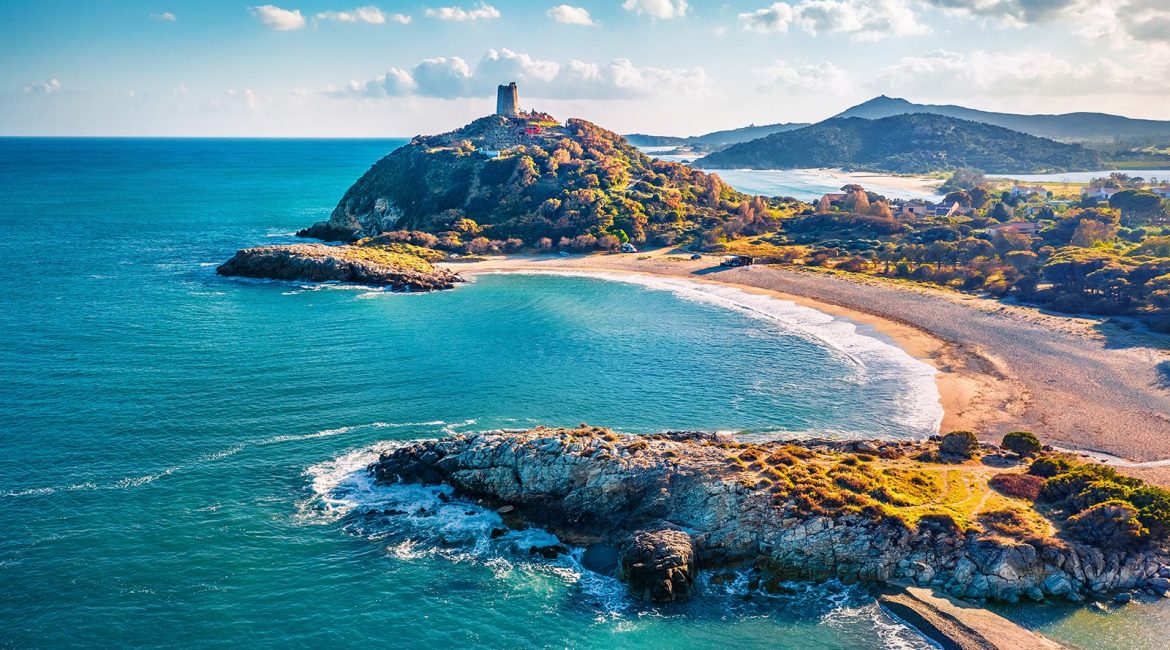
Continuing from here, a succession of the most beautiful beaches follows: Teulada, Capo Malfatano, Piscinni, Tuerredda, Cala Cipolla, and Chia. Choose the one you like best and enjoy the marvelous water. Personally, I really appreciated Cala Tuerredda because it is a beach with two swimmable sides facing a small uninhabited island that you can swim to—packed with fish for snorkeling enthusiasts.
The sixth day ended at Eden Rock, a small settlement of houses nestled in a huge pine forest, surrounded, as the name suggests, by a paradise of rocks forming imaginative compositions.
Final Stage: From Eden Rock to Cagliari
The last stage was very easy: 40 km, almost entirely flat, passing the wonderful beaches of Pula and Nora to reach the city of Cagliari. Pula Beach is a long strip of sand equipped for young people and families, full of seaside attractions and restaurants. Nora, which I preferred, is a very striking beach adjacent to an interesting archaeological park. To get there, you need to ride along a short dirt road, but the effort is well worth it given the rocks, crystal-clear sea, and numerous seagulls waiting for a truly relaxing holiday day.
From here, the road to Cagliari isn’t the best. You can take the increasingly crowded main highway or a section of dirt road through the mountains. There is little elevation gain and plenty of adventure until you emerge at the last “swimmable” beach, La Maddalena, a strip of sand filled with kitesurfers.
Continuing further, taking the main highway becomes mandatory. You will pass through Cagliari’s industrial area (not very scenic) and cross long bridges that lead directly into the center of Sardinia’s capital. Be careful with the traffic.
Return to the Urban Setting: Cagliari
Cagliari is a fairly large city with a historic center that unfolds along two pedestrian streets with Piazza Jenne at the middle, featuring a continuous climb and descent of cobbled alleys. High above stands the castle with its impressive bastions, the main one being Saint Remy. The city is bustling with shops and small restaurants.
If you are still looking for a bit of relaxation and nature, I recommend visiting Cala Mosca, which boasts a beach and a wonderful venue, Le Terrazze. For the rest, let yourself be enchanted by the city’s Spanish-influenced atmosphere and lively nightlife. Although very touristy, the city will bring you back to “civilization” before heading home.
A Tip for Those Traveling on Two Wheels and Taking a Flight
If you are looking for bike boxes or assistance for your bicycle, head to the Cimar shop on Via Sassari. It is located a stone’s throw from the central station, from where the train will take you to the airport in just 10 minutes.